
Why Choose Guilin for Your Destination Wedding
Every destination-wedding page tells you the scenery is breathtaking. Guilin's genuinely is — but that is not a reason, because every destination says it, and "breathtaking" does not help you choose between two places you have both seen photographs of.
So here is the case for Guilin made out of things you can check, and one number that decides more than all the photographs put together.
Guilin sits at 153 metres above sea level.
Hold that for a moment. We will come back to it, and it is the single most useful fact on this page.
1. The guest list problem nobody warns you about
If you are marrying in China with family flying in, your wedding is not a holiday for a young, fit couple. It is a multigenerational trip. Your parents are coming. If you are lucky, a grandparent is coming. Aunts, uncles, someone's new baby, someone recovering from a knee replacement. Half of them are getting on a fourteen-hour flight for the first time in a decade.
That changes which parts of China are actually available to you — and it is a filter almost nobody applies until they are already attached to a place.
The most-photographed wedding landscapes in China are in Yunnan. And the numbers there are not small:
| Where | Elevation |
|---|---|
| Guilin | 153 m |
| Lijiang (city centre) | ~2,400 m |
| Jade Dragon Snow Mountain — viewing platform | 4,506 m |
| Jade Dragon Snow Mountain — upper boardwalk | 4,680 m |
Visitors to that last one routinely buy cans of compressed oxygen to get through it.
Those are extraordinary places and we plan weddings there. But be clear about what you are asking of the people you love: a seventy-eight-year-old flying from Toronto, landing at 2,400 metres two days before your ceremony, then going up a cable car to nearly fifteen thousand feet.
Guilin is roughly 2,250 metres lower than Lijiang. Nobody in your family will need to acclimatise, nobody will be buying oxygen, and the ceremony you are picturing is at the bottom of the valley rather than the top of a mountain.
This is not an argument that Guilin is better than Lijiang. It is an argument that they suit different guest lists, and that the guest list is the thing you actually have, not the thing you get to choose. If your list is thirty people under forty, Yunnan is wide open to you. If your list is fifty people spanning three generations, the altitude question should be settled before you fall in love with a photograph.
Ask it this way: who is the least mobile person you would be genuinely sad not to have there? Now plan for them. Everything else in this article is downstream of that answer.
2. The landscape is not a matter of opinion
The usual problem with scenery claims is that they are unfalsifiable. This one is not.
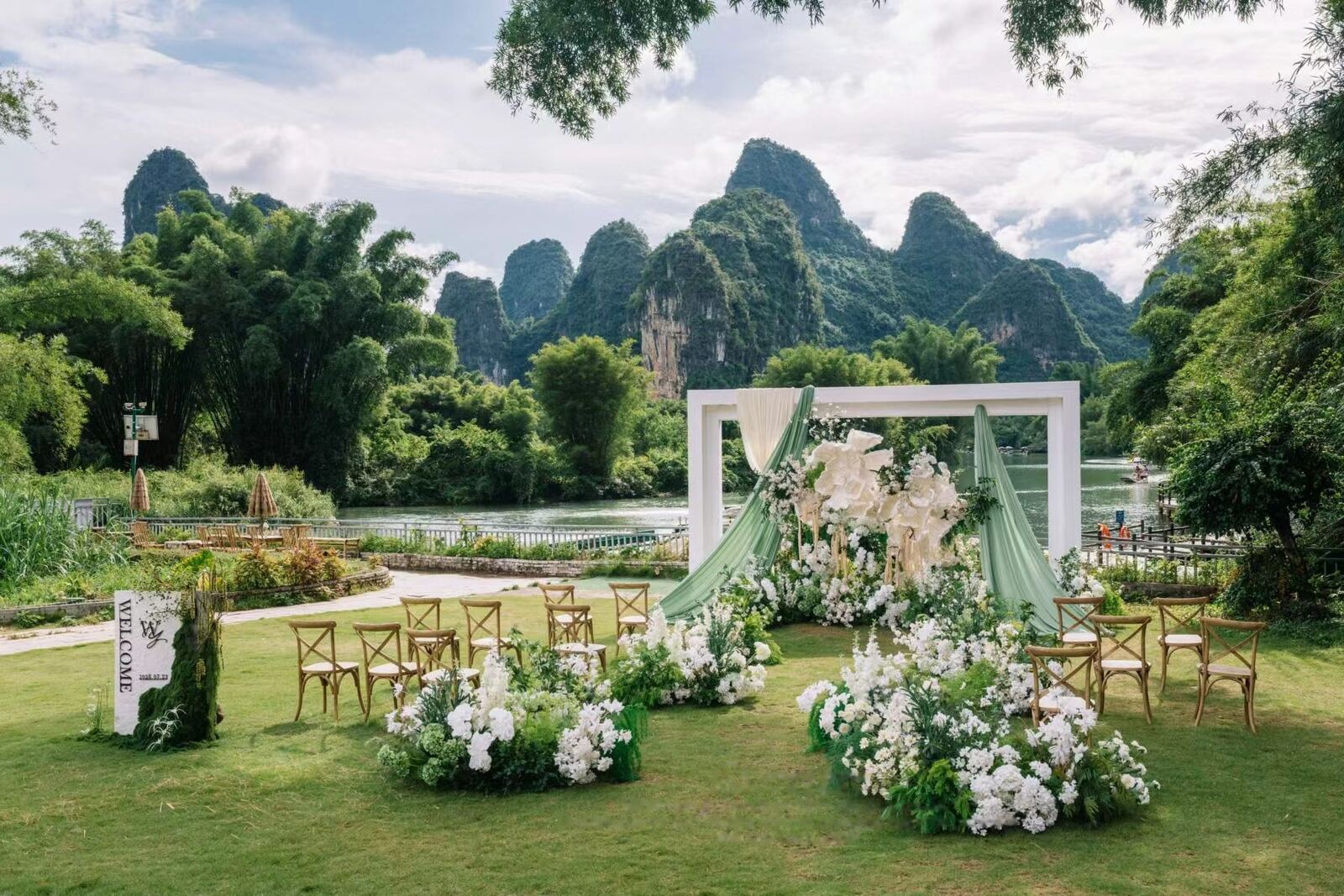
Guilin's karst was inscribed on the UNESCO World Heritage List in 2014, as part of the serial South China Karst property — Phase II, alongside Shibing, Jinfoshan and Huanjiang, joining the three Phase I sites listed in 2007. It is inscribed under criteria (vii) and (viii): exceptional natural beauty, and outstanding geological significance.
The second half is the interesting one. UNESCO describes Guilin as the best-known example of continental fenglin — tower karst — and "a perfect geomorphic expression of the end stage of karst evolution in South China". Because water runs in from the surrounding hills, tower karst and cone karst (fengcong) develop side by side here in a way they do not elsewhere, and the research done on it produced what geologists call the Guilin model of how the two forms evolve together.
Which is to say: those peaks are not simply pretty. They are the textbook. When your guests stand in front of them and cannot quite work out what they are looking at, that reaction is the correct one — this landform is the reference specimen for its own category.
And the country put it on the money
The reverse of the Chinese 20 yuan note is Guilin scenery — the Li River, in the stretch commonly identified as the water near Xingping, below Yangshuo.
We like this fact for a practical reason, not a romantic one. Your guests will be holding your wedding backdrop in their hands within an hour of landing. Out of everything a country could have chosen to represent itself, it chose this valley. There is no stronger third-party endorsement of a landscape than a central bank engraving it.
It also solves a small social problem you have not thought about yet: explaining to friends where you are getting married. "Guilin" means nothing to most Western guests. "The mountains on the Chinese twenty" lands instantly, and half of them will realise they have already seen it.
3. A ceremony that is only possible on this geology
Most destination weddings offer you a version of the same ceremony: a lawn, a terrace, a beach. The setting changes, the format does not.
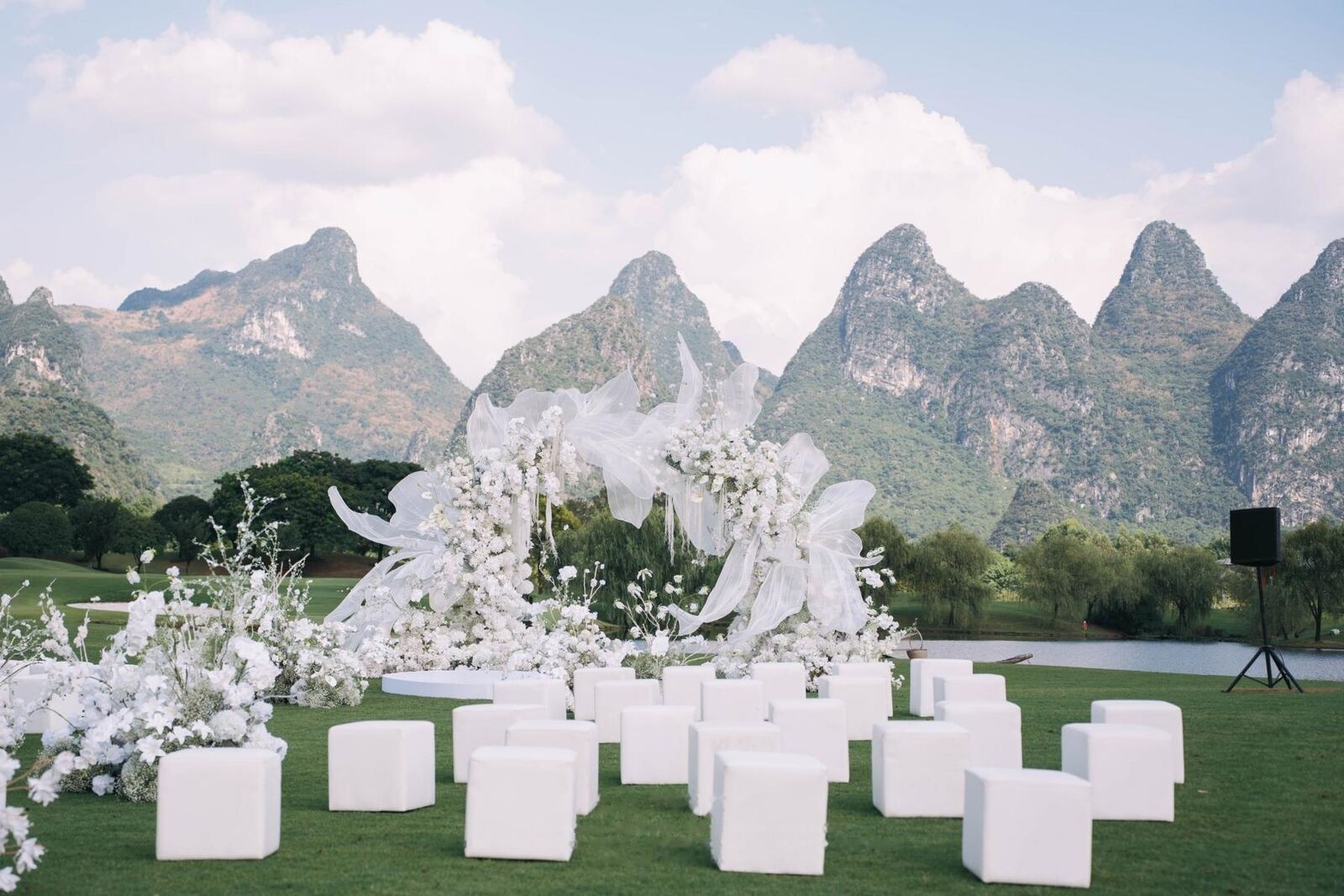
Guilin offers a format that does not travel. Venues along the river build shallow water platforms — you stand on a few centimetres of still water, the peaks rise behind you, and the whole scene doubles in the reflection. There is no lawn equivalent of that photograph, and there is no way to build one somewhere flat.
We have seen this priced on a real 2026 quotation: ¥30,000 for the day at one riverside hotel, negotiated down from a ¥50,000 list rate, with afternoon tea for fifty guests included. Our full cost breakdown works through that whole quotation line by line.
The wider point: choose Guilin for the thing that can only happen in Guilin. If your plan could be executed identically in Bali or Portugal, you have picked a backdrop rather than a destination, and you will feel that later.
4. Getting people there is a solved problem — with one caveat
The caveat first, because it is the honest order. Guilin Liangjiang International Airport serves three international destinations: Kuala Lumpur, Hong Kong and Seoul. No guest is flying to Guilin directly from London, Toronto, Sydney or New York. Everyone connects.
What makes that manageable is the Hong Kong route. There is a direct high-speed train from Hong Kong West Kowloon to Guilin West — three services a day, the fastest covering the 580 km in about three hours. For guests coming from North America or Europe, that is a familiar, English-speaking, heavily-served airport followed by a comfortable train, rather than a second flight and a second unfamiliar terminal.
Compare that with the Yunnan alternative, which for most international guests is a long-haul flight, a domestic connection, and then altitude on arrival.
If your venue is out toward Yangshuo rather than in Guilin city, note that there is no direct Hong Kong–Yangshuo train; guests transfer at Guangzhou or Shenzhen, and Guangzhou South to Yangshuo runs about three hours.
One planning consequence: because everyone connects, you should pick the connection for them. Twelve guests solving the same routing problem independently produces twelve different answers, several of them expensive. One recommendation per origin region, written once on your wedding site, saves you a month of messages.
5. The money behaves differently here — and not in the way you expect
We will not tell you Guilin is cheap, because the honest version is more useful.
On a real 2026 quotation for a fifty-guest wedding at a riverside hotel near Yangshuo, the banquet came to ¥4,888 a table — about ¥489 a head for ten courses, with drinks excluded and bring-your-own permitted. Corkage-free alcohol is a rare permission at a Western wedding venue and an ordinary one here. Photography, video, makeup and the wedding host together were ¥16,000 for five professionals across eight hours.
By any Western benchmark, those are remarkable numbers.
And then: accommodation on that same quotation was 55% of the total bill. A good hotel is a good hotel anywhere, and the moment your guests are staying rather than driving home, the largest line in your budget is rooms — not the ceremony, not the flowers, not the food.
So the real financial case for Guilin is not "it is inexpensive". It is that the expensive parts of a Western wedding are inexpensive here, and the part that stays expensive is the part you can decide about. Whether you cover your guests' rooms is a genuine choice, and it moves your budget more than every other decision on this page combined.
6. When not to get married in Guilin
Any page that only argues one way is selling you something. Here is the case against, with the same sourcing as the case for.
Guilin is wet. Annual rainfall is just under 1,890 mm — about three times London's — and it is not spread evenly. Roughly half of the year's rain falls between April and June, the plum-rain season, which carries a real risk of flooding. Average relative humidity peaks at 81% in June.
That is awkward, because April to June is also when the valley is at its greenest and most photographed. The most beautiful months carry the most weather risk, and any planner who tells you otherwise is not looking at the rainfall record.
July and August are hot — averaging around 28°C — and January is genuinely cool, with daily minimums near 6°C, in a region where indoor heating is not a given.
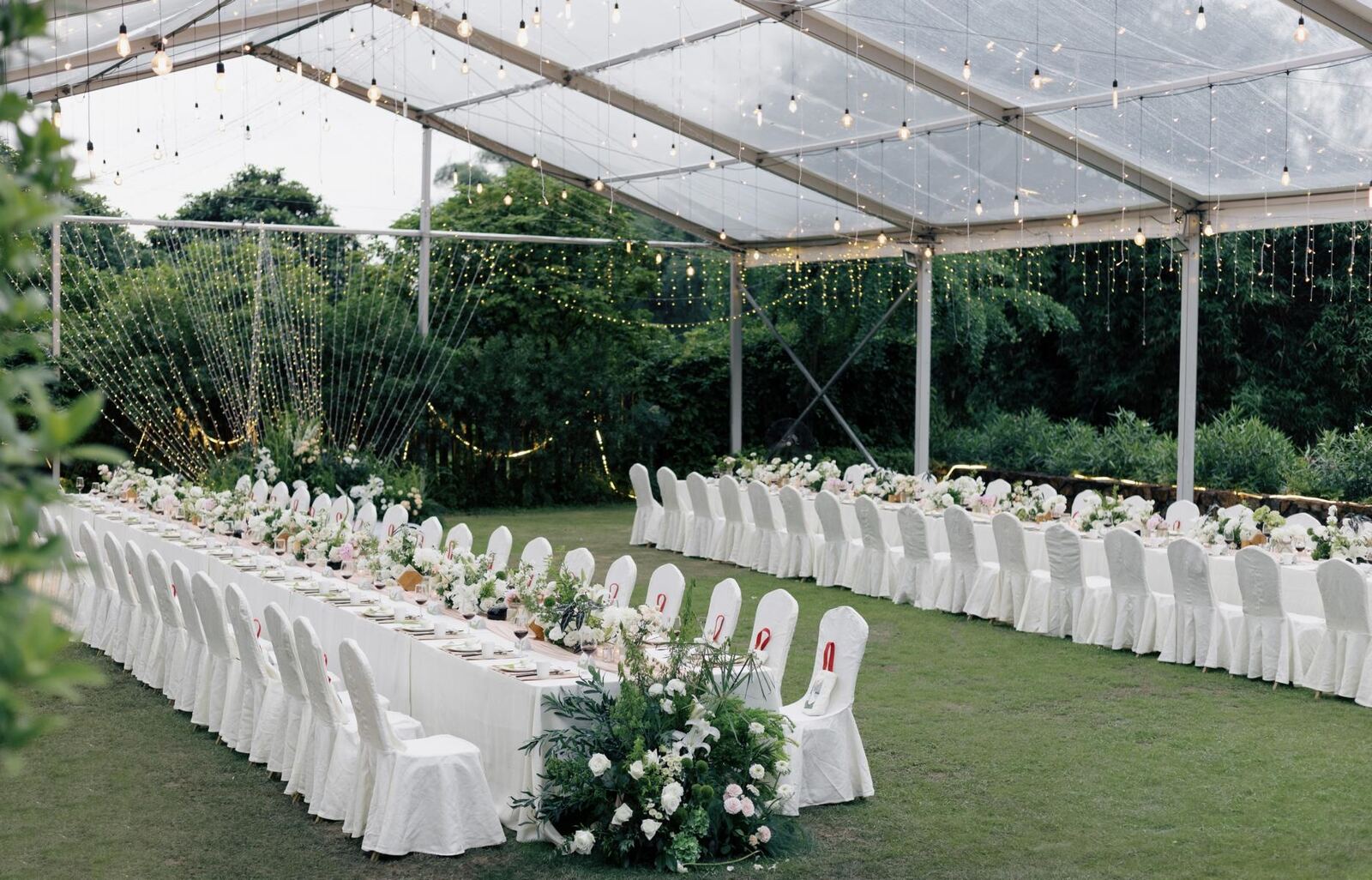
What this means practically: an outdoor ceremony here needs a real wet-weather plan, in writing, with a named indoor alternative and a decision deadline — not a verbal assurance that it will probably be fine. Ask your venue what happens at 4pm on the day if the river is high. If they do not have an answer, that is your answer.
And one honest gap: we are frequently asked about mist and fog on the river, which is famous in photographs and less charming when it sits on your ceremony. We have the rainfall record; we do not yet hold reliable month-by-month fog data for the Li River valley specifically. We would rather say that than guess, and we are working on it with our planner on the ground.
So: is Guilin right for you?
Probably yes, if:
- Your guest list spans generations, and someone in it should not be at altitude
- Half your guests have never been to China, and you want somewhere they can picture before they arrive
- You want a ceremony format that could not be replicated anywhere else
- Guests are routing through Hong Kong anyway, or would happily do so
- You are willing to plan around weather rather than pretend it away
Probably not, if:
- Your heart is set on snow-capped peaks in the frame — that is Yunnan, and it is worth the altitude if your guest list can take it
- Your only workable dates are April to June and an outdoor ceremony is non-negotiable
- Your family's own hometown is elsewhere in China, and the point of marrying there is that it is theirs. That is a better reason than any landscape, and we would tell you to follow it.
That last one matters. For a couple coming back to China to marry so their family can be present, the right destination is sometimes not the most beautiful one. Guilin's case is strongest when you have no particular place calling you home, and you want the version of China that your guests can reach, tolerate and remember.
Frequently asked questions
Is Guilin or Yangshuo the better base?
Guilin has the airport and the rail connection; Yangshuo has more of the river and the karst directly around it. Many couples stay in Yangshuo and route guests in through Guilin. Yangshuo is roughly an hour and a half south.
Do we need to speak Mandarin?
Not to get married here, though you will want someone who does on your side of the table — for the venue contract, the vendor calls, and the parts of the day your parents will care about. That is much of what a local planner is for.
Is it too touristy?
The Li River is one of the most visited landscapes in China, so the honest answer for the famous viewpoints is yes, in season. Wedding venues sit on private stretches of river, which is a different experience from the public ones — ask any venue directly what is visible from their site and who else has access to it.
Can we combine the wedding with the rest of a trip?
This is one of Guilin's quieter advantages: guests who have flown a long way will want more than one day. The river, the rice terraces and Yangshuo itself give a three-to-five day visit real shape without anyone needing to organise it.
When is the best month?
We are not going to give you one until we can source it properly. What we can say from the record: April to June carries about half the annual rainfall, July and August are hot, and January is cool. Autumn is the window most often recommended — treat that as a starting point for a conversation with someone on the ground, not a guarantee.
Sources
- South China Karst — UNESCO World Heritage Centre — Guilin Karst inscribed 2014 (Phase II), criteria (vii) and (viii); "best known example of continental fenglin"; the Guilin model.
- Guilin — elevation and climate record — 153 m; ~1,890 mm annual rainfall; ~50% falling April–June; humidity 65% (Dec) to 81% (Jun); July–August ~28.4°C; January minimum ~6.1°C.
- Climate of London — ~627 mm annual precipitation, Kew Gardens 1991–2020 (the rainfall comparison).
- Lijiang — elevation — 2,400 m city centre.
- Jade Dragon Snow Mountain — observation platforms at 4,506 m and 4,680 m; visitors carry compressed oxygen.
- 20 Yuan, People's Republic of China — Numista — reverse depicts "Scenery of Guilin".
- Hong Kong–Guilin high-speed train — direct West Kowloon to Guilin West, three daily services, fastest ≈3 hours over 580 km; no direct Hong Kong–Yangshuo service.
- Guilin Liangjiang International Airport — international destinations: Kuala Lumpur, Hong Kong, Seoul.
- Cost figures: a real 2026 wedding quotation held on file — see our Guilin cost breakdown.
Where to read next
- What a Guilin Wedding Actually Costs in 2026 — a real ¥270,440 quotation, line by line.
- Lijiang Destination Wedding Guide: Value, Culture & Cost — the Yunnan alternative, if your guest list can take the altitude.
Not sure whether Guilin or somewhere else in China fits your guest list? Take the China quiz — four minutes, and we will come back with a shortlist built around who is actually coming.
Ready to Start Your Journey?
Every couple's story is unique, and we're here to help you tell yours in the most beautiful way possible. Whether you're dreaming of a destination wedding or refining your plans, our team is ready to support you.
Related Articles
Lisbon vs. Algarve vs. Madeira: Choosing Your Dream Portugal Wedding Location
Lisbon's elegance, the Algarve's coast, or Madeira's island romance? A 2026 side-by-side on venues, cost, access, and season to choose your Portugal wedding region.
Top 10 Stunning Bali Wedding Venues for 2026: Cliffside Drama to Jungle Serenity
Discover the most breathtaking wedding venues in Bali for 2026. From the dramatic cliffs of Uluwatu to the serene jungles of Ubud, we rank the top 10 spots for your dream celebration.