
What a Guilin Wedding Actually Costs in 2026: A Real ¥270,440 Quotation, Line by Line
Most articles about wedding costs in China give you a range. A range is useless, because the thing you actually need to know is not how much — it is what is in the number and what is not, and a range hides exactly that.
So here is a real one instead.
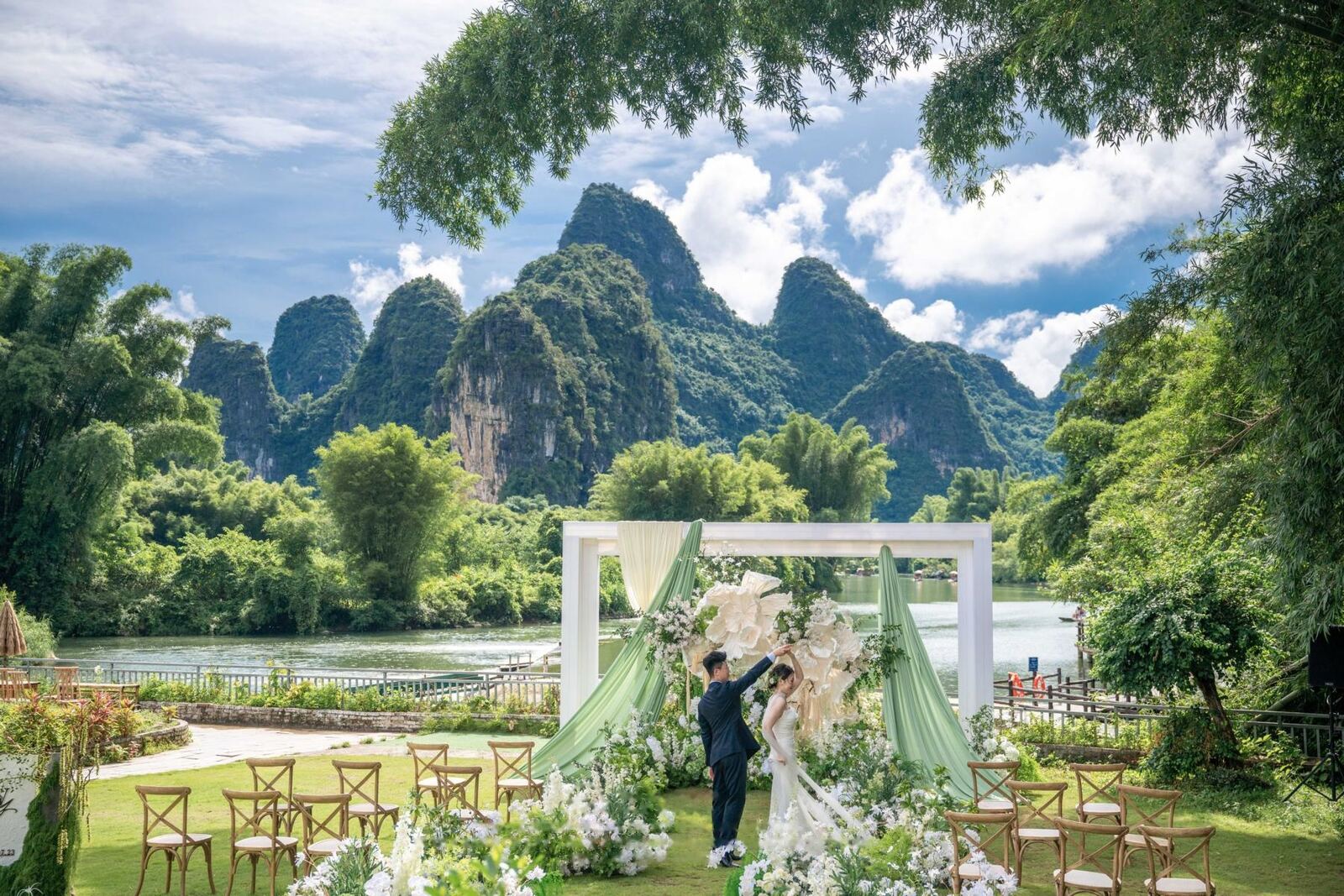
This is an itemised 2026 quotation from a Guilin wedding production company for a wedding at a riverside hotel in Yangshuo, about an hour and a half south of Guilin, in the karst landscape most couples picture when they picture this part of China. Fifty guests. Five tables. One wedding day. Two nights of rooms. Five line items and a total.
That total is ¥270,440 — roughly US$40,200 at the September 2026 rate.
If that number is higher than you expected, keep reading, because the interesting part is not the total. It is the shape of it, and the shape is not what almost anyone assumes.
The quotation
| Line | What it covers | Total |
|---|---|---|
| Guest rooms | 28 rooms × 2 nights, for 50 people | ¥150,000 |
| Decoration & setup | One day, 12-person build team | ¥50,000 |
| Ceremony platform hire | The venue's water-feature platform, one day | ¥30,000 |
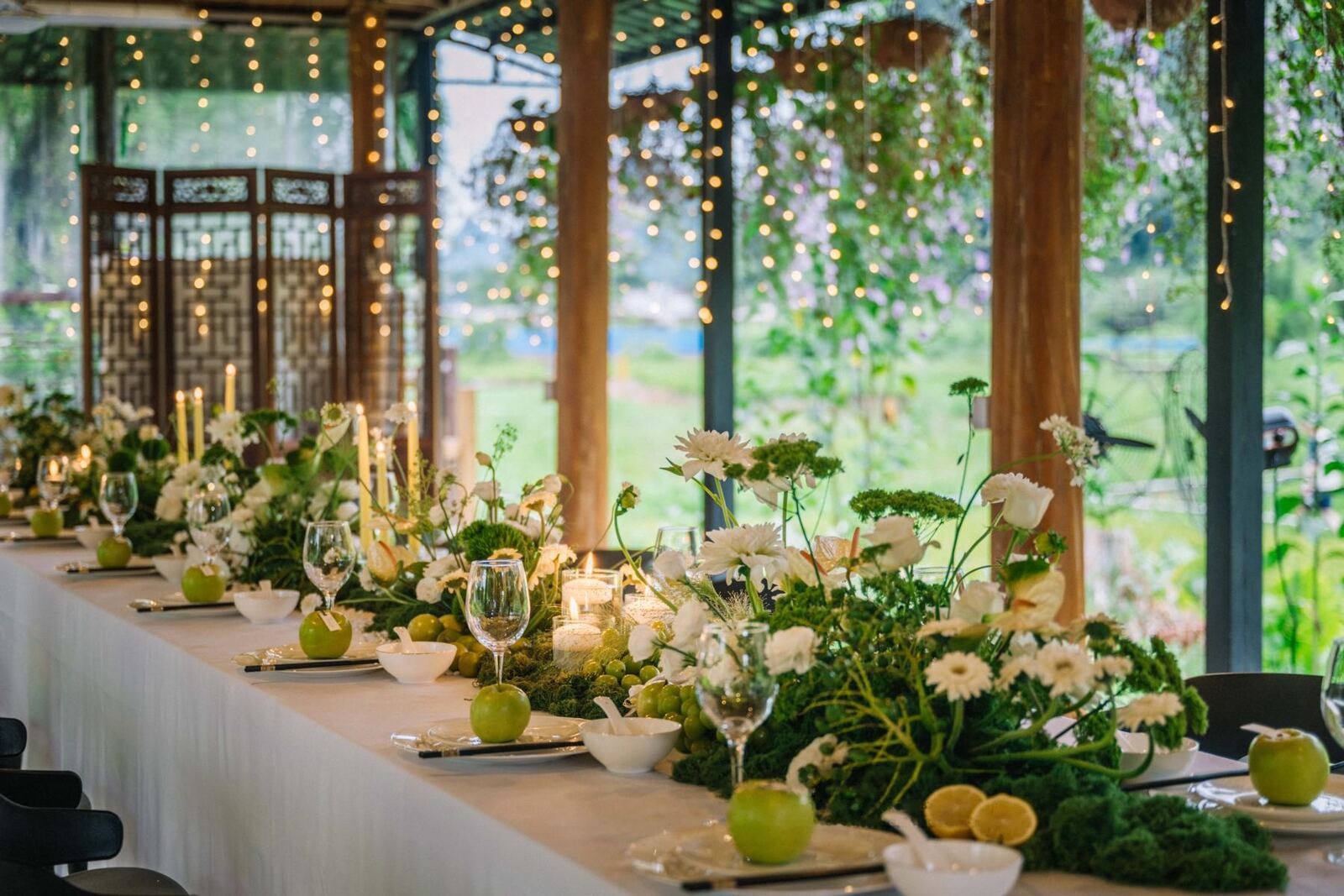
| Banquet | 5 round tables of 10, at ¥4,888 a table | ¥24,440 |
| Crew | Photographer, videographer, makeup artist, host — 5 people, 8 hours | ¥16,000 |
| Grand total | ¥270,440 |
≈US$40,200, converted at ¥6.73 to US$1 (Federal Reserve H.10, 28 August 2026). Rates move; the yuan figures are the real ones.
That is ¥5,409 a guest — about US$804 each.
The finding: this is a hotel bill with a wedding attached
Fifty-five and a half percent of this quotation is rooms.
Twenty-eight rooms for two nights, at ¥150,000. That single line is larger than the decoration, the ceremony platform, the banquet and the entire creative crew combined — those four lines together come to ¥120,440.
Almost every "what does a wedding in China cost" article you will find leaves accommodation out entirely, because it is answering a domestic question. A domestic couple's guests drive in, eat, and go home. Your guests are flying in from Vancouver and Manchester and Boston, and they are staying. The moment that is true, the biggest number in your wedding budget is a hotel bill, and it is not close.
Which reframes the whole planning conversation:
Take the rooms out and the same wedding costs ¥120,440 — about US$17,900, or ¥2,409 a guest. The wedding did not change. What changed is who pays for the beds.
This is the first question to settle, before venues, before dates, before anything. Are you covering accommodation, are you covering some of it, or are you blocking rooms and letting guests book their own? Those are three completely different weddings with the same ceremony. Nobody will ask you this. Ask it yourselves in month one.
The banquet is the cheapest big thing on the list
Five tables of ten at ¥4,888 a table — ¥489 a head, about US$73. Nine percent of the total.
Two things worth knowing about that line:
Drinks are excluded, and you can bring your own. The quotation says so explicitly: menu excluding drinks, BYOB permitted. That is not universal and it is genuinely valuable — corkage-free alcohol is a rare permission at a Western wedding venue and a normal one here. If you have a wine budget, this is where it goes furthest.
Per-head catering at ¥489 is not a compromise price. A ten-course Chinese banquet at a good hotel is a substantial meal. If you have been pricing weddings in Europe or North America, the instinct is to read ¥489 as the budget tier. It is not. Ask what the tiers above and below actually change before you assume you need to trade up.
The line that was discounted 40%, and what it tells you
The venue's ceremony platform — a shallow water feature you stand on, with the karst peaks behind you — lists at ¥50,000 for the day. The quotation prices it at ¥30,000, described as a venue booking discount price obtained through the planner. Afternoon tea for fifty guests is thrown in.
That is ¥20,000 off one line — and 7.4% of the entire wedding.
We are showing you this for a specific reason, and it is not to sell you a planner. It is because the list price of a venue is frequently not the transacting price, and a couple booking directly from abroad, in a second language, has no way of knowing where the give is. Here the give was 40% on a five-figure line, and it did not come from haggling. It came from a company that books that venue repeatedly.
What to do with that: whatever route you take, ask any venue you approach whether the rate they quoted is their published rate or their booking rate. It is a normal question. The answer costs you nothing and is occasionally worth twenty thousand yuan.
The crew line answers a question we could not answer before
¥16,000 buys five professionals for eight hours: photographer, videographer, makeup artist, and the host.
That last one matters more than a Western reader will guess. At a Chinese wedding banquet the 主持人 — the host, the MC — runs the room. They hold the timeline, call the sequence, and carry the ceremony. There is no clean Western equivalent; they are not a DJ and not a celebrant, and a good one is remembered for years.
Here is the thing that trips up couples planning from abroad: the host does not appear on the vendor's à-la-carte price list at all. Read that list on its own and you would conclude no host exists, and you would build a budget without one. They are not sold separately. They arrive inside the crew, and the crew is a single ¥16,000 line covering five people.
So the question to ask a Chinese wedding company is not "how much is a host?" It is "who is in the crew, and is the host one of them?"
Decoration: ¥50,000, twelve people, and why it is not comparable to a ballroom
The build is ¥50,000 for one day with a twelve-person team, and the quotation is candid that the figure moves: different decoration styles result in different prices.
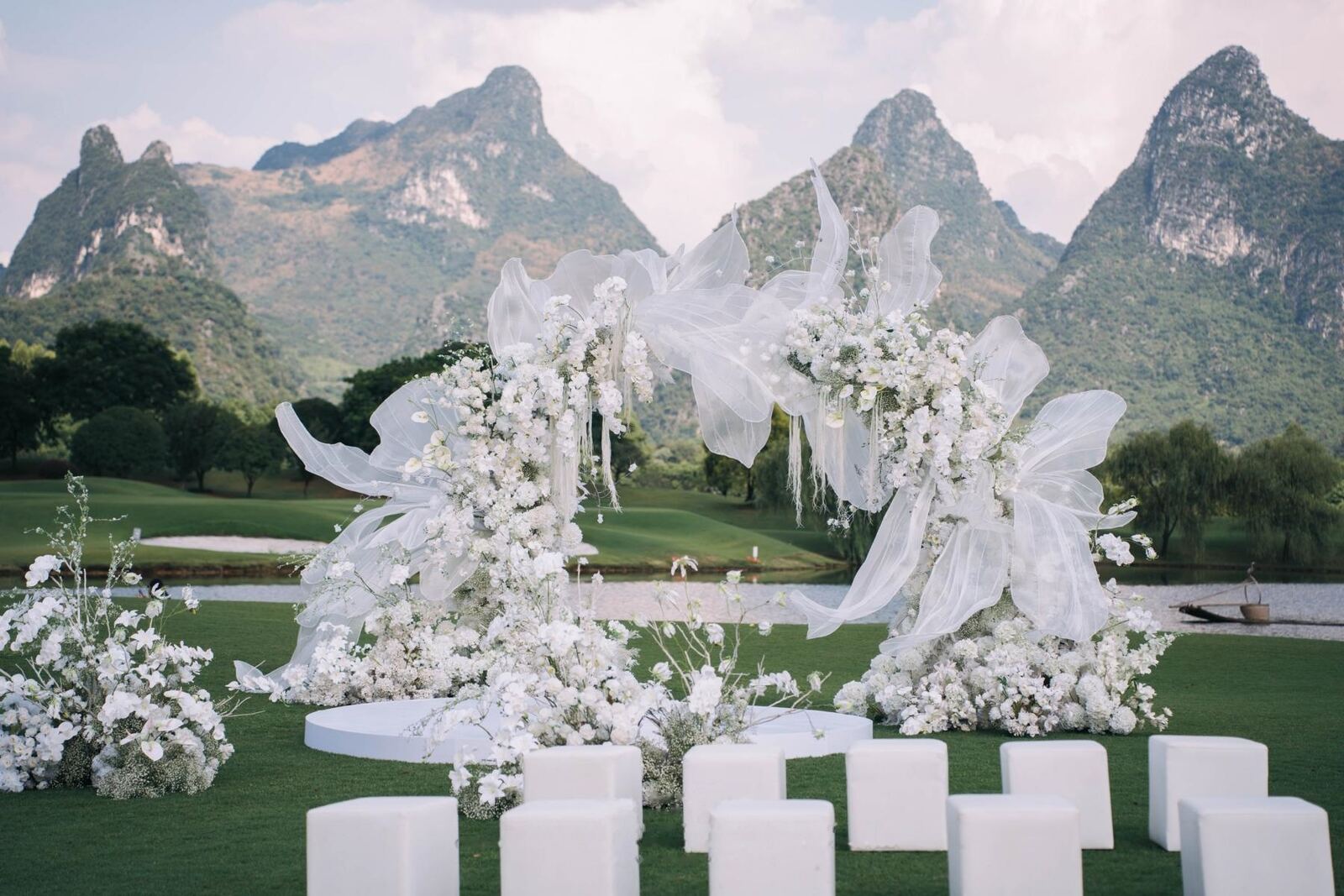
Worth understanding why this is roughly double what the same company's unit-rate catalogue would produce for a hotel ballroom. You are not dressing a room. You are building a set on a water platform in open landscape, which means everything is carried in, assembled outdoors, weather-exposed and struck the same night. Twelve staff for one day is what that costs.
There is also a surcharge to ask about directly: the quotation notes a daily transport fee when the Yangshuo build team has to travel out of town, and — a detail worth flagging — the English and Chinese versions of that same note give two different figures. If your venue is any distance from the team's base, get that number confirmed in writing rather than reading it off a template.
What this quotation still does not include
It is an unusually complete quote. It is not a complete wedding. Missing, and each one is a separate conversation:
- Flowers, beyond what is inside the decoration build — bouquets, buttonholes, personal florals.
- Dress, suit, hair (the makeup artist is in the crew; hair may not be).
- The pre-wedding shoot, which in China is a separate production with its own day, its own crew and its own price. Many couples treat it as non-optional.
- Transport — airport transfers, and moving fifty people to a venue outside town.
- The planner's fee, where it is not folded into the build.
- Anything for your guests beyond the wedding day — a welcome dinner, a next-morning breakfast, activities.
- Your own flights, and any portion of your guests' that you cover.
And one structural unknown worth asking about: whether the venue imposes a minimum number of tables. This quote is five tables. A couple planning thirty guests may not clear a minimum, and that constraint decides venues faster than price does.
How to read a Guilin quote, in five questions
Whoever you are talking to, these five get you further than any amount of price comparison:
- Is accommodation in this number, and for how many rooms and nights? This is more than half the bill. Everything else is detail until you have settled it.
- Is the venue rate quoted a published rate or a booking rate?
- Who is in the crew, how many hours, and is the host one of them?
- Is there a minimum table count, and what does the next menu tier up actually change?
- What is excluded? Ask for the exclusions in writing. A good vendor will send them the same day.
About the number, so you can judge it rather than trust it
- This is a real quotation issued by a Guilin wedding production company for a named venue in Yangshuo at 50 guests. Every figure above is from that document.
- It is a quotation, not a settled invoice. It is a real quoted price, not a receipt for a wedding that has been paid for, and we are not going to describe it as one.
- One venue, one company, one configuration. A different venue, a different guest count or a different build produces a different number. The shape — rooms dominating, banquet smaller than expected, host inside the crew — is the transferable part.
- The vendor and the venue are not named here.
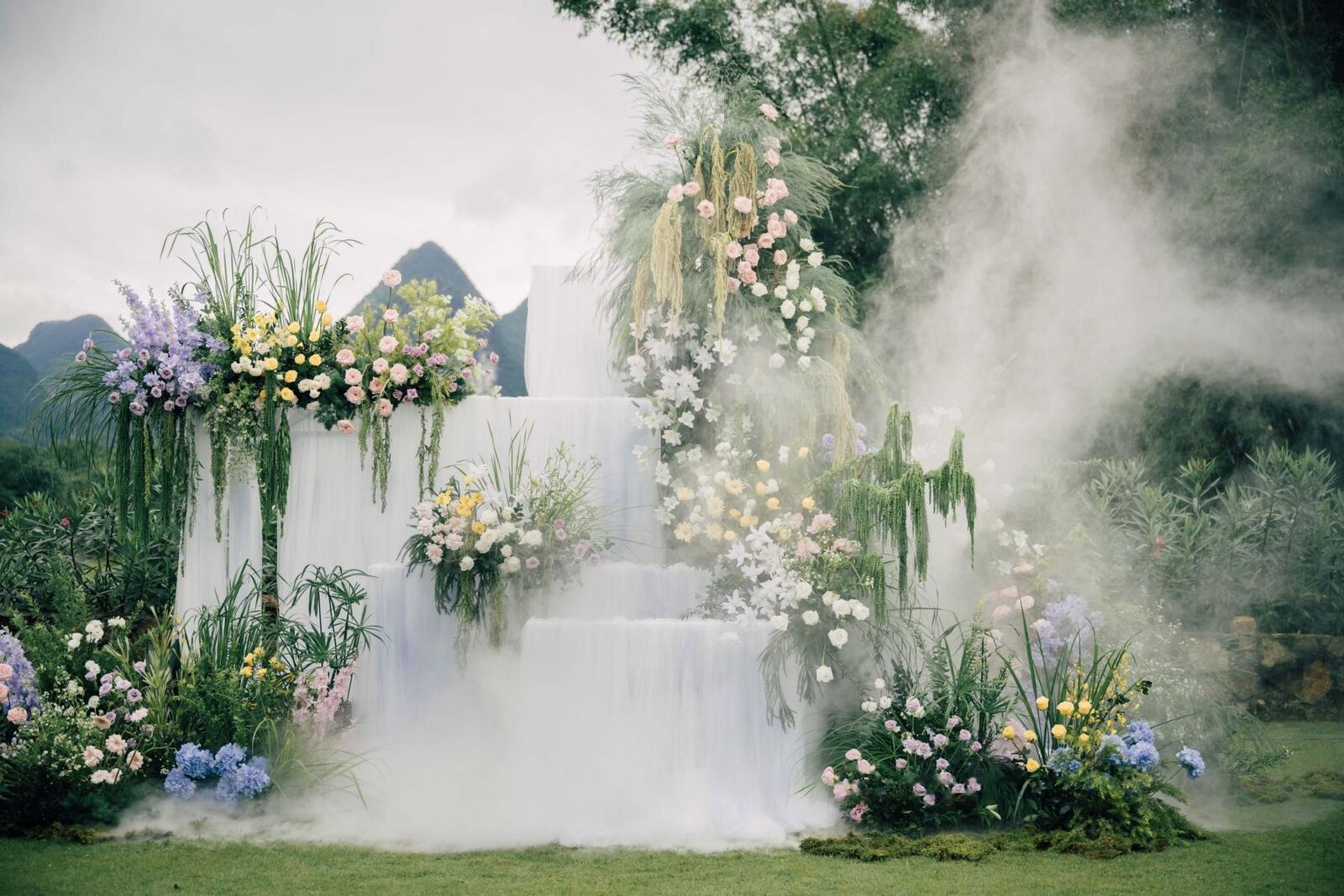
- The photos show recent wedding builds around Yangshuo and Guilin. They illustrate the setting and the scale of a build; they are not photos of the quoted venue.
- Converted at ¥6.73 to US$1 (Federal Reserve H.10, 28 August 2026).
Frequently asked questions
Is ¥270,440 typical for a Guilin wedding?
It is a real quote for a 50-guest wedding at a well-appointed riverside hotel with two nights of rooms for everyone. Change any of those three and the number moves a long way. Strip the rooms and the same wedding is ¥120,440.
Why are rooms more than half?
Twenty-eight rooms for two nights at a resort-standard property. Roughly ¥2,679 a room-night on the two-night rate — the quotation shows a single night for the same block at ¥80,000, so staying two is cheaper per night than staying one.
Is a wedding in Guilin cheaper than one in Europe?
On production, catering and crew, substantially. On accommodation, not necessarily — a good hotel is a good hotel anywhere. Which is exactly why the rooms question decides your budget and the ceremony does not.
Can we really bring our own alcohol?
This quotation permits it. Do not generalise it to every venue — confirm it in writing, and ask whether corkage applies.
We are planning 30 guests, not 50. Does everything scale down?
Not evenly. Rooms and catering scale almost linearly. The build, the platform hire and the crew barely move — a twelve-person team and an eight-hour photography crew cost the same for thirty guests as for fifty. Expect your cost per guest to go up as your guest count comes down.
What is the single biggest lever on this budget?
Whether you pay for your guests' rooms. Nothing else on this page comes close.
Where to read next
- Why Choose Guilin for Your Destination Wedding — the altitude, the landscape, the months to avoid, and when Guilin is the wrong call.
- Lijiang Destination Wedding Guide: Value, Culture & Cost — the same question, answered for Yunnan.
- Traveling to China: What Foreign Couples Should Expect — internet, payments and the practical friction before you arrive.
Want a quote shaped like this for your own guest count? Take the China quiz and we will come back with venues, a build and a number.
Ready to Start Your Journey?
Every couple's story is unique, and we're here to help you tell yours in the most beautiful way possible. Whether you're dreaming of a destination wedding or refining your plans, our team is ready to support you.
Related Articles
The Ultimate 3-Day Portugal Wedding Itinerary: From Lisbon Sunsets to Algarve Brunches
Planning a wedding weekend in Portugal? Discover our definitive guide to crafting the perfect 72-hour celebration, complete with venue tips and budget breakdowns.
Can You Legally Get Married in China? What It Means for a Guilin or Lijiang Wedding
Since 1 April 2019, two foreign citizens cannot register a marriage in China — and because China does not recognise dual nationality, \"I was born there\" may not make you Chinese. What that means for a wedding in Guilin or Lijiang, and the sequence that works.