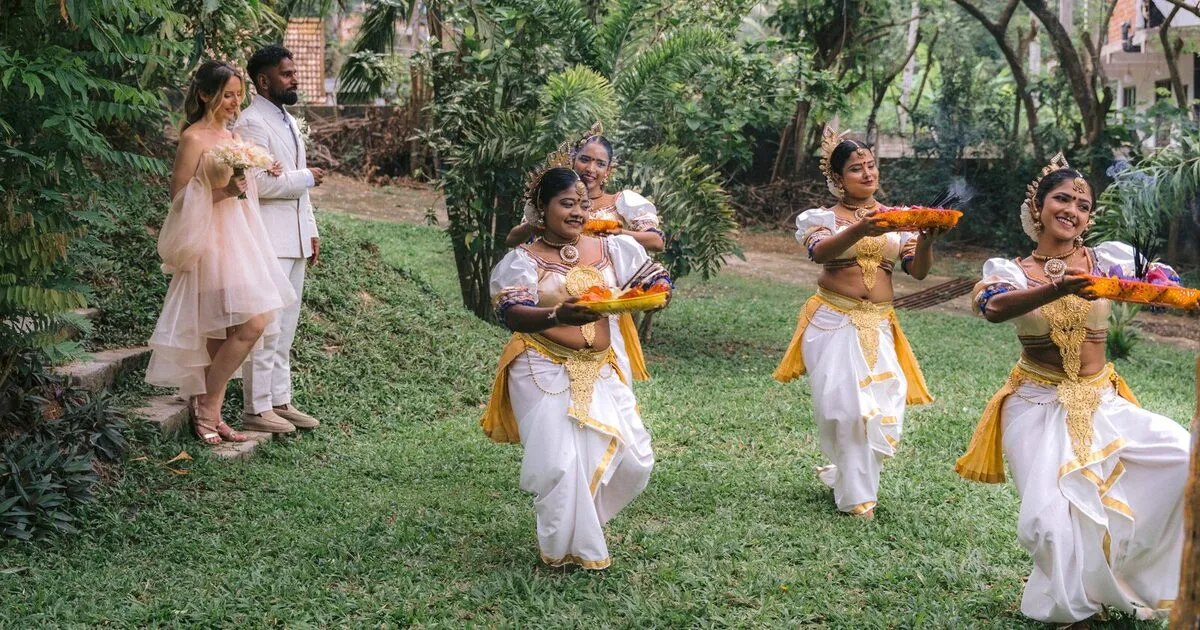
The Poruwa Ceremony: A Sri Lankan Tradition at Your Wedding
A Poruwa ceremony is the traditional Sinhalese wedding rite, held on a decorated wooden platform called the poruwa. Today it is a cultural ceremony, not the legal registration, which happens separately. Foreign couples can include one as a symbolic part of their Sri Lanka wedding, and Dilani's view is that it works for couples of any faith, as long as it is done properly and explained to the guests.
It is the part of a Sri Lanka wedding that no other destination can offer. This guide explains what happens on the poruwa, how it sits alongside the legal side, and how to include it with respect rather than as a costume.
Dilani Gomis leads Weddings by Dila and is based near Colombo. She has about ten years of wedding planning behind her, specialises in destination weddings, and works in English and Sinhala. Before weddings she managed IT and software projects, and she reads every brief herself. The photographs in this guide come from weddings she planned, with Kandyan dancers and Sinhala-language details woven into the day.
Last checked: 20 November 2026.
What the poruwa is
The poruwa is a raised wooden platform, decorated with flowers, white cloth and traditional motifs, on which the couple stand for the ceremony. The rite performed on it, sometimes called the poruwa siritha, is the centrepiece of a traditional Sinhala wedding.
It has deep roots. Ceremony masters in Sri Lanka trace the tradition back to the marriage of Prince Siddhartha and Princess Yashodara. Before the British introduced the legal registration of marriages in the 19th century, the Poruwa ceremony itself was recognised as a marriage. Today the two are separate: the Poruwa is the ceremony, and a Registrar makes the marriage legal.

What happens on the poruwa
Every family and ceremony master does it a little differently, and many modern ceremonies are shortened. These are the elements guests most often see:
- The auspicious time. Traditionally, an astrologer sets the nekath, the auspicious moment for the couple to step onto the poruwa.
- The ashtaka. A ceremony master recites ashtaka verses, blessings for the couple, while the rituals take place.
- The oil lamp. The couple, often with family, light a traditional oil lamp as a symbol of a bright future together.
- The thread and the water. The couple's little fingers are tied together with a thread, and water is poured over them, a symbol of the bond.
- Betel leaves and gifts. The couple offer betel leaves to their parents and elders as a sign of respect, and gifts pass between the families.
- Blessing verses. A group, often young girls, sings the Jayamangala Gatha, verses of blessing from the Buddhist tradition, as the couple step down.
Your ceremony master will explain the order, and Dilani can tell you which elements she suggests for a couple marrying from abroad.
Can foreign couples have a Poruwa ceremony?
Yes. Because the Poruwa is a ceremony and not the legal registration, couples who are not Sri Lankan can include one as a symbolic part of the day, alongside a Western-style ceremony or on its own. Many Sri Lankan couples already combine the two, with the Poruwa followed by a white-dress ceremony or a hotel reception.
Some elements, such as the Jayamangala Gatha, come from Buddhist tradition. Dilani's view is that the Poruwa works for couples of any faith. If faith matters to you or your families, ask her to walk you through the order and adapt it with the ceremony master.

How to include it with respect
The difference between a moving Poruwa and an awkward one is preparation. A few rules:
- Use a real ceremony master. The ashtaka is recited by someone trained in it. Ask Dilani to book one, rather than a performer.
- Explain it to your guests. A short printed programme, or a few words from your celebrant, tells guests what each ritual means. It turns watching into taking part.
- Involve your families. Several rituals honour parents and elders. Decide in advance who stands where.
- Dress with care. If you would like to wear Sri Lankan dress, such as a Kandyan osariya, ask Dilani to arrange a fitting with a local dresser, so it is worn properly.
- Keep the legal side separate. Our guide to marrying in Sri Lanka as a foreigner covers the registration, or you can marry legally at home first.
Where it fits in the day
The Poruwa can be the main ceremony, or one of two. Common shapes include a Poruwa in the morning at the auspicious time and a Western-style ceremony at sunset; a Poruwa followed straight away by the signing of the register; or a Poruwa as the opening of the reception, with Kandyan dancers leading the couple and guests in.
Any of these works at a beach hotel, in a garden or in a ballroom. Our guide to beach weddings from Bentota to Tangalle covers venues on the coast.

Questions couples ask
What is a Poruwa ceremony?
It is the traditional Sinhalese wedding ceremony, held on a decorated wooden platform called the poruwa. A ceremony master recites ashtaka verses while the couple take part in rituals such as lighting an oil lamp, having their little fingers tied with a thread, and offering betel leaves to their elders.
Can foreigners have a Poruwa ceremony in Sri Lanka?
Yes. The Poruwa is a cultural ceremony, not the legal registration, so couples who are not Sri Lankan can include one as a symbolic part of the wedding. It is best done with a trained ceremony master, a planner who knows the rituals, and a short explanation for guests.
Is a Poruwa ceremony legally binding?
No. It was once recognised as a marriage, before the British introduced the legal registration of marriages in the 19th century. Today a marriage is legal in Sri Lanka only when it is registered by a Registrar. Many couples sign the register straight after the Poruwa, or marry legally at home.
Is the Poruwa ceremony religious?
It is rooted in Sinhala Buddhist tradition, and some parts, such as the Jayamangala Gatha blessing verses, come from Buddhism. Dilani's view is that the Poruwa works for couples of any faith as a cultural ceremony. If faith matters to you, ask your planner and ceremony master to adapt the order.
How long does a Poruwa ceremony take?
It varies with the rituals you include and the ceremony master. Many modern ceremonies are shorter than traditional ones. Ask your planner for a running order so you can fit it around the rest of the day, especially if the start time follows an auspicious moment.
Plan the day with Dilani
If Sri Lanka is the country, send Dilani your brief. Not sure Sri Lanka is the one? Take the Vibe Quiz.
You may also want the guides to a wedding in Galle Fort and to a wedding and honeymoon on one trip.
Related Articles
Tuscany vs the Amalfi Coast: Choosing Your Wedding Region
Tuscany or the Amalfi Coast for your wedding? Decide by your guest list, not the photos: where everyone sleeps, how they move, and your least mobile guest.
Eloping or a Small Wedding in South Africa
How to elope in South Africa: the legal steps for two foreigners, why you need two witnesses, and small venues from Table Mountain to the Garden Route.